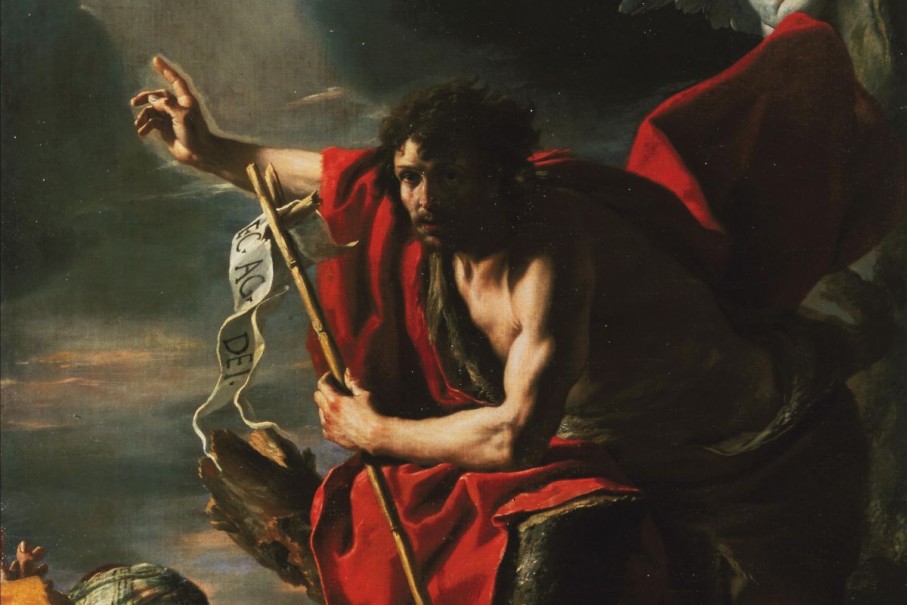
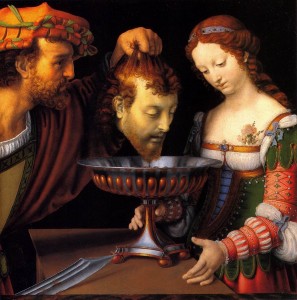
The Prophet and his King. The prophet, John the Baptist is already acknowledged a saint. And his martyrdom is en eloquent testimony to his fidelity to the Word he spoke of and witnessed to till the very end of his life. We emulate John’s humility in keeping grounded on the mission that is his: not to be the Bridegroom but simply Best Man; not to be the Way but simply, the Voice that cries by the Wayside; not to be the Light of the World but simply the lamp–one who is the Prophetic servant of the Word and not the Word which is God’s Word.
John must have had a gut-feel that he was going soon. For he referred his closest disciples to Jesus, the one he baptised and declared “Behold the Lamb of God!” In a moment of weakness, he entertained some doubt and sent a group to ask Jesus, “Are you the one we have been waiting for?” perhaps mainly because Jesus’ very compassionate, forgiving style was very different from his loud, prophetic judging style.
But Jesus patiently explained to John’s followers so they can relay the message to John himself: “Look at the signs–the messianic signs. They’re all here.” Then Jesus invites John to receive him fully so he may enter the Kingdom proclaimed and now inaugurated. I believe John overcame his doubt and embraced Jesus as he declared in time, “I must decrease so he may increase.”
But just for today, I invite all to reflect on the flipside of the story of John’s martyrdom, a story we may tend to gloss over because it is the story of an antagonist. It is after all Herod’s birthday when John met his martyrdom. Too bad that the circumstances which brought John to his final destiny were marked by frivolity, lust, revenge, false honour, and public shame. The order that sealed John’s fate somehow sealed Herod’s sin as well.
I’d like to believe though that there was something in the words of the Prophet that was somehow awakening God’s Spirit in Herod’s heart. If he only paid attention and listened to God’s stirrings, the story would have had a different turn. The Gospel attests that for the longest time, Herod just kept John in custody, to do damage control to the Prophet’s condemnation and to appease the King’s paramour who was already feeling the sting of John’s condemning words. Herod was after all King of the Jews and he was brazenly breaking the law of marital fidelity by living with his brother’s wife Herodias.
But Herod was drawn by John’s words. He liked to listen to John. There was something about the Prophet’s preaching that moved him. And he was perplexed. There was something about John’s preaching that confused him, unsettled him, made him entertain questions. For a sinner. confusion can be a good sign. Ignatius considers “shame and confusion” consolation graces especially for a sinner who is awakening to the reality of sin in his or her life and of a merciful and loving God calling him or her to a reordering of life.
There is nothing more difficult in a retreat than a sinner who is blinded or worse refuses to acknowledge the evil in one’s ways. Thus we know that the Word of God which the Prophet John spoke was also awakening faith and penitence in the King. But alas on the King’s birthday, he was overcome by lust and attachment to his power and false honour. And whatever mustard of seed of faith that was sprouting and growing slowly was abruptly choked and wounded for naught.
We pray that in our lives, when we hear God’s Word spoken through a prophetic channel, we have hearts open enough to hear and to listen, to be drawn and moved to action, to embrace and live God’s Word in our lives so God’s Spirit may find new incarnations in our life story and the life stories of people around us. God Bless!
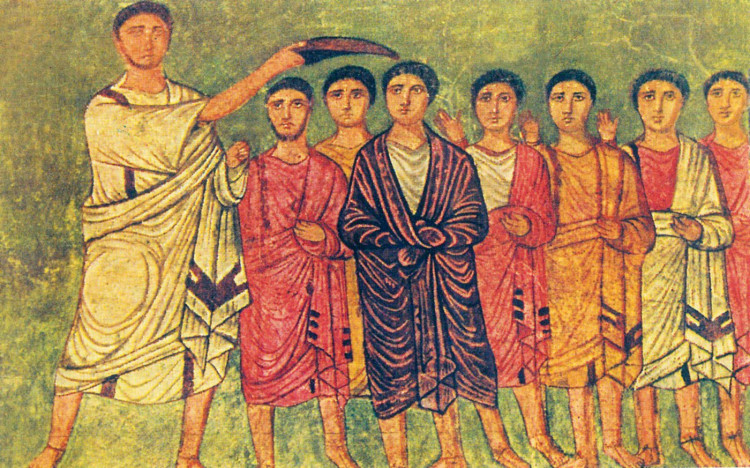
Choice of David as a Model for the choice of Matthias
To Pray on and Ponder: Acts 1, 15-17.20-26; John 15, 9-17
Scenes in the new testament of the early Christians exercising discernment as regards the choice of leaders or missioners always fascinate me. The group goes through preparatory steps which include quiet and prayer, yet in the end they draw lots. In the case of the choice of who was to replace the betrayer Judas to fill the vacancy in the Twelve, our first reading says, “the lot fell on Matthias.” They did make a choice (discerned hopefully!) as to who would form the short list of candidates they’d present before the Lord. And the reading says, they had criteria in forming this short list: the men had to be part of their group since the Lord was baptized by John, they had to have journeyed with them through the public ministry of Jesus and they should have been witnesses to the Resurrection of Jesus as the other eleven were. When the list was cut down to Justus and Matthias, it was then when they applied their simplest discernment method of all–drawing lots.
We may laugh at this scene, but if we really think about it, a big part of the fruit of discernment is in fact shaped by events which we do not control, events which are governed pretty much by chance. For sure we do not draw lots for our leaders these days when we do discernment, yet the whole process leaves much to chance just the same. Many times qualified leaders arise when there is a confluence of factors: timing, good repute at the time of choice, long time preparations, public awareness, value preferences of the electorate at the time of choice and the espoused value platforms of the candidates in view, source of funding, opponents and their influence, and then unexpected boosters or dampers of a candidate’s chance effected by factors in the environment. Even the preparedness of a candidate at the time of choice may or may not be a big factor depending on the prevailing climate in the elections.
We’d like to believe that the Holy Spirit moves about and uses many of these personal and contextual factors to draw good from whatever imperfect candidate or election system we employ, even when sometimes the worst choices come out of an election season, we can say, perhaps this phase is needed so the Spirit can educate and form our electorate into better and more carefully discerned choices in the future.
But our Gospel reading presents to us an underlying truth about discernment of leadership. While it’s true that a lot about our choosing is governed by chance, the outcome is never something which is accidental: the leader who comes out is chosen and sent by the Lord, and because chosen and sent by the Lord of Love, he is commissioned to govern in love, in the deepest meaning of love there is: “to lay down one’s life for his friends.” It is in this that the Holy Spirit acts most intensely–when God’s love is able to reach God’s people through the leaders chosen and sent to be precisely instruments of that love.
It could be that God’s kairos and the mysterious workings of confluence, coincidence, serendipity and the meeting of fortuitous events have given rise to a person for a particular mission at a particular time, but we can be sure the it is love that chooses and sends that person into the post and it is love that will make his or her work fruitful. That part is never left to chance. And where that love goes to garbage bin, you can be sure the leader will follow suit. Leaders may wield power in a corrupt and abusive way for some time, but God in his love for his people will always raise people who will challenge such leaders with a mind to greater justice, compassion, peace and the wellbeing of his people. God bless!
“God labouring” is a beautiful image of God that St. Ignatius gives us in the final “Contemplation of Obtain the Love of God” proposed in the Spiritual Exercises. Ignatius wanted us to take a long, loving look at how God’s love brings him to labor constantly for our redemption. God is in constant labor, so that we may learn to love the way God loves. When God redeems us it is not without personal involvement and investment.
In this connection, it was curious and ironic to read this statement in today’s Gospel chosen for the Memorial Feast of St. Joseph the worker: “He did not work many mighty deeds there because of their lack of faith.” It seems that the one limit that God places on the efficacy of his labouring is that we who are on the receiving end of God’s work, meet God with hearts of faith. For like many miracles in the Gospels, it takes God’s power and the human person’s faith to make a miracle work.
We look at St. Joseph and notice certain qualities of his that make him a good model of a person of faith.
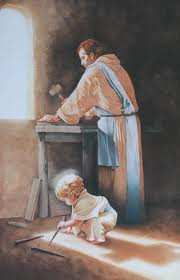
First, the general orientation of his life as the Gospels would describe him was that he was “a just man”– a man who was concerned that the woman he loves and who was betrothed to him was not exposed to the risk of condemnation because Mary was found to be with child. He did not quite understand this at first but he was going to settle this by quietly divorcing Mary. I could imagine Joseph playing the role of a good mentor to Jesus in the latter’s growing up years–teaching Jesus about the faith, about prayer and also about his craft in wood works and preparing Jesus for whatever he may be called to do when he comes to his own.
Second, I am sure Mary had a significant role in Jesus’ life of prayer, but I can also imagine Joseph teaching Jesus the ways of Jewish prayer for men. If later on Jesus’ focal prayer was to be the “Our Father” I’d like to believe all notions of fatherhood that Jesus grew into would have been shaped by his own consciousness of the kind of fathering that Joseph had modelled for him. And so immediately we can reflect on values like singleminded focus on the Kingdom, radical faith in Divine Providence, humble dependence on God’s mercy, the capacity to forgive and to ask for forgiveness, the resolve to fight evil in the power of God.
Third, Joseph would have been a good model of one who made himself totally available to God’s Will. We can assume that he was a very quiet person–one of the Gospel characters we know who does not have a single recorded word in the Gospels. We know that God would have been deep into his unconscious as God’s summons even appear in his dreams and in waking hours he would act with dispatch to bring those dreams into reality. If the Holy Family survived the many life threatening crises they went through, it’s because of Joseph’s protection and care. And this protection always included listening to where God was leading them and trusting God’s lead would bring the family to safer grounds. This was true when they had to flee Bethlehem and escape to Egypt on account of the threat that Herod posed. The same was true when Joseph decided to bring their Holy Family home to Nazareth when news about the death of Herod the Great spread through the lands.I resonate strongly with Jesus films which portray Jesus as grieving deeply the early death of Joseph because Jesus must not have been quite ready yet to go public, and yet he had already lost an important mentor in his life. But Jesus must have already learned well from Joseph and Mary, precious habits of prayer and discernment to help him get by until he went out into his public ministry.
We thank the Lord, for the gift of St. Joseph and for giving us in him the necessary graces to work our faith so we can meaningfully participate with God as continues to labour the redemption of the world. God bless!
To Pray on and Ponder: Ezekiel 37, 12-14; Psalm 130, 1-8; Romans 8, 8-11; John 11, 1-45
Id quod volo (that which I desire most): I see Christ modelling for me what genuine love means and confirming my own small efforts to love genuinely as God does.
While in the thick of ministry, Jesus is summoned by beloved friends Martha and Mary. Their brother Lazarus, also a close friend of Jesus was very sick and in mortal danger. But Jesus decides to defer his coming. In obedience to his Father’s will, he postpones his coming so that “God’s glory may be revealed.” When friends peg their hope on you to save the life of their brother, it must be quite difficult to give this reason for not coming immediately. In not responding in haste, Jesus has risked his close friendship with the sisters.
When the opportune time to come arrives, Jesus does come to Bethany at the risk of the sisters’ rebuke and the risk of an encounter with his enemies from the Sanhedrin. Jesus listens to the sisters’ lamentations. But conversing with them, he is able to elicit from them very deep professions of faith that he will indeed raise Lazarus to life some day. Jesus deepens their faith even more. Jesus does not only have the power to raise Lazarus on the last day, He is himself the author of life and thus he has the power to restore Lazarus immediately, especially so that God’s glory will be revealed.
There is no doubt that Lazarus had already died when Jesus came. The curious detail of Jesus’ coming on the fourth day since Lazarus died testifies to this. The Jews believed that it is only on the fourth day when the soul leaves the body and moves on to Sheol, the place where the dead go. But Jesus being the author of Life, orders the tomb stone rolled and after intense prayer, calls forth Lazarus. He orders that Lazarus be unbound from the linen that covered him, a sign that signified the freeing of Lazarus from the cudgels of sin and death.
But what my instincts tell me as one of the more important details in this story is this: as a result of the great impact of the event of Lazarus’ raising on the people, the pharisees and scribes begin to conspire and resolve to send Jesus to death. Indeed, Jesus’ giving back life to Lazarus also meant that he was sealing his fate on the cross, death on the cross. The important detail to notice is this–that before Jesus raises Lazarus, Martha professes a faith in Jesus comparable only to Simon Peter when she says, “Yes Lord, I have come to believe that you are the Christ, the Son of God, the One who is coming to the world.”
Alas giving life to a friend has a cost. Genuine love of friends challenges us to soften the limits we put on self-giving. Real love for a friend goes beyond loving from our surplus, or loving with condition, or loving because of an expected “return on investment”. For Jesus it was trusting radically in his Father’s love who after all was ultimately not asking Jesus to abandon his friends, but to wait for the opportune time when a fuller love can be made manifest. In the end indeed, we come home once more to this: “no greater love there is than this: to give ones life to a friend.”
And yes, we are all, by the standard of the cross that seals our Christian identity, called to stand by this truth by the very disposition of our lives. How might we bring to life this religious truth as we live in the mess called COVID-19? How might “giving one’s life to a friend look like for you in these weeks and months? How might “no greater love” be the kind of response the comes out of us these days. Whereever this discernment leads each of us, God will continue to be the wellspring of light and love for every discerning disciple. God Bless!
To Pray on and Ponder: Exodus 17, 1-7; Psalm 95, 1-2.6-9; Romans 5, 1-8; John 4, 5-42.
A biblical scholar, Robert Alter once talked about how literary motifs are traceable in scripture stories and give us some way of making sense of literary symbols and themes. This morning we use the alternative readings offered by our lenten liturgy for today’s Catholic mass. The readings feature “water stories” obviously to highlight for us the significance of this archetypal symbol of water in the baptismal motif of the lenten liturgy. The first reading from Exodus features the story of the Israelites’ grumblings when in the middle of the desert, they realized that they were trapped in a life-threatening situation of having no water. In the midst of this crisis, they grumble against Yahweh and Yahweh’s prophet Moses. They were close to cursing and stoning Moses, blaming him for returning to Egypt to take them from the security of their slaves’ life in Egypt. Slave though they were, at least they had food to eat and water to drink. In response, Yahweh orders Moses to strike the rock of Horeb. When Moses struck the rock, the rock opened up so to speak, and a flowing spring welled up form the rock so people had all the water to drink.
I could almost hear echoes of the psalm proclaiming and inviting us, “If today you hear his voice harden not your hearts.” Allow the Word of God to speak to your heart, to strike it with the prophet’s rod, open it so life can well up and flow, let God take away your heart of stone and in its place put a heart of flesh, a heart that knows love.
The second reading from the Letter to the Romans uses the same figure of water for “the love God poured out into our hearts through the Holy Spirit who has been given to us” when Christ offered his life for us “while we were yet sinners.”
The Sunday Gospel features the story of the Samaritan Woman who comes to Jacob’s well every day to fetch water at high noon. One may ask, why high noon? And we will have a hint after reading a bit more. This woman would not dare come to the well in the morning or at dusk when most people fetch water. She probably did not like being exposed that way to people’s gossip or ridicule because of her life–Jesus would describe this life in passing: “You are right in saying, ‘I do not have a husband.’ For you have had five husbands, and the one you’re have now is not your husband. What you have said is true.”
But how this woman’s identity is transformed from possibly being an adulterer to a woman who takes responsibility for the truth of her life to a witness and proclaimer before all her townsfolk is something to behold and contemplate. Slowly Jesus converses with this woman and allows the embers of her desire for greater truth and more genuine worship to grow and be set ablaze. For as the woman becomes more and more honest with herself and transparent before Jesus, Jesus’ identity is also revealed to her and to us gradually, from a mere “Jew, asking a samaritan woman for a drink” to a bearer of “spring of water that wells up to eternal life,” to a “prophet” to “Messiah” to a true “savior of the world.”
Returning to our biblical scholar, Robert Alter once wrote that in the Old Testament this scene of an encounter between a woman and man by the well is a motif that often occurs in betrothal settings. Such was employed by writers of stories involving the patriarchs’ betrothal to thematriarchs they eventually lived with, eg. Abraham-Sarah, Isaac and Rebekkah, Jacob-Rachel/Leah. But we may ask why Jesus and the Samaritan woman? Were they being betrothed to each other? We can probably say that in this case, the intimate bonding was not strictly for betrothal but it is still an intimate bond being formed, a welling up of faith in a people who are not all confined to Jewish tradition, especially in the light of Jesus’ prophecy that “time will come when people will worship the Father, not on this mountain nor in Jerusalem . . . . (but) in Spirit and truth.”
Right there and then, we get a glimpse of the power of Jesus’ word as he transforms the heart of this woman and makes her a witness that brings a whole town to faith in him. Like the two disciples who walked to Emmaus after the days of the resurrection, these Samaritans had a chance to listen to Jesus directly and began to believe in his words, their desires welling up in their hearts like they did in the woman, so that they pleaded with Jesus to stay with them.
We may pause here and reflect: How have intimacy been growing in your own prayer and conversations with Jesus? How has Jesus been a wellspring of water welling up life and desire in your hearts as you hear his voice more constantly and in an increasingly penetrating way? Have you sensed some call to greater truth in yourself? greater honesty and integrity? Have you sensed some call to embrace the Spirit of love and wisdom and generosity? How has your being real to God occasioned for you as well God’s being more real to you? What new facets of God are you discovering as you deepen your relationship with God in greater trust and radical honesty? And perhaps, these days of the COVID-19 pandemic, might Water of Life being offered to us in some new form that is a lot more subtle and hidden? In what ways of “outpouring” does Jesus come to us to awaken us to thirsts kept hidden deep because we have been so preoccupied with other superficial thirsts? As Gerald Manley Hopkins once portrayed in a verse,
” Thee God to Thee, Go. All day long I like fountain flow. From Thy hand out swayed about, mote-like in Thy mighty glow.”
To Pray on and Ponder: Genesis 12, 1-4a; Psalm 33,4-5.18-22; 2 Tim 1, 8b-10; Matthew 17, 1-9
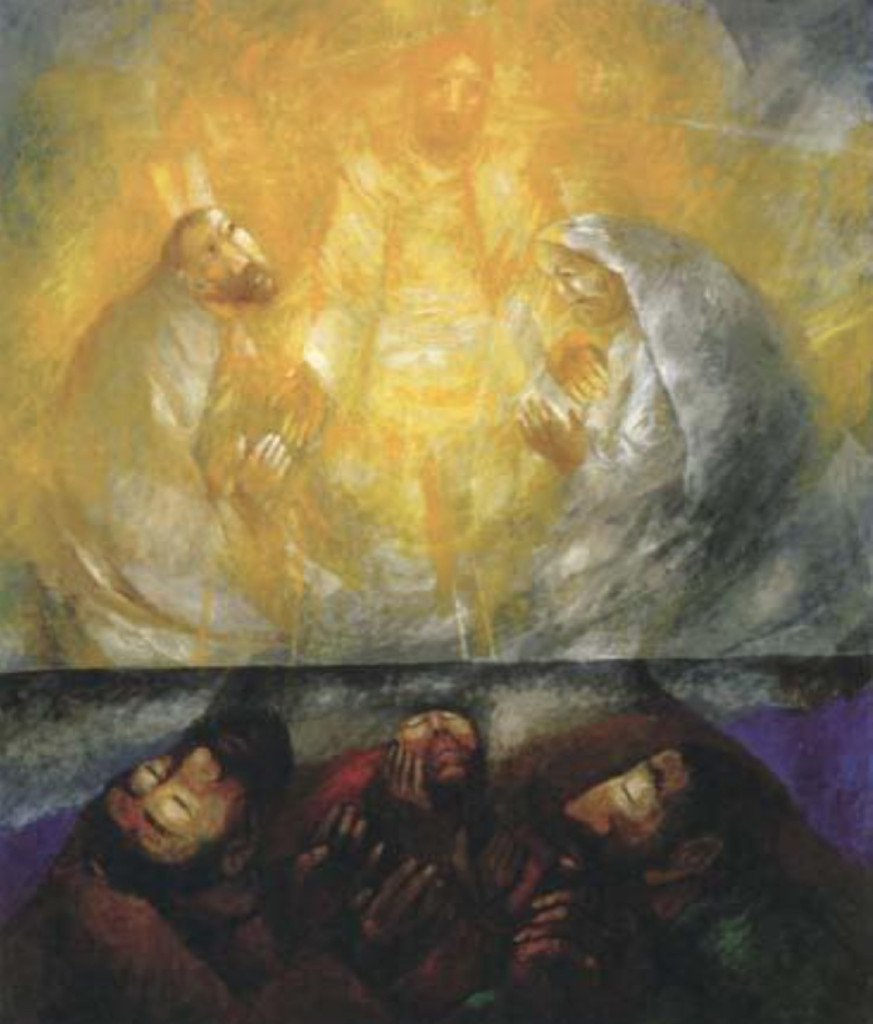
Id quod volo (That which we desire most): To encounter Jesus whose personal integrity and passion shine forth as the Father confirms his deepest identity as Son and expresses deep delight in his faithful and passionate embrace of his mission as Messiah. To notice in ourselves and take consolation when such resonant experiences happened us and made our faces shine as brightly.
I am sure that the mystery of the Transfiguration of our Lord carries meanings that are more than we can ever explain or imagine, but just for this morning, let me propose to you three human experiences that make a person’s face shine. Perhaps these ordinary human experiences may somehow help us make sense of the deeper mystery of the Lord’s transfiguration. I’ve seen these human experiences happen to myself and to other people especially in the context of profound religious experiences.
First, I’ve seen a face shine when the person comes to terms with a reality that he or she has been struggling with. It may be a problem whose resolution has been long in coming. Or a period of grieving for some loss has passed. Or the person experience the joy of discovering a key element in a problem or coming an insight to a question that has bugged her for some time now. In these situations, the person’s face shines because things have fallen into place and each piece of the puzzle so to speak has begun to make sense in a whole picture that has finally emerged. This experience of a puzzle coming to place was in fact something that a friend shared with me when I asked her how her previous long retreat went. She said Vic, do you remember that grade school science demonstration which our teachers did to teach us about magnetism. You know the teacher takes a sheet of paper, places some iron fillings on the paper and then she puts a magnet under the sheet and lo and behold, the iron fillings come together and form a pattern. When our teacher moves the magnet about, the whole bunch of iron fillings moves with it. You know Vic, before that retreat, I was like those scattered pieces of iron fillings, and in the retreat, God was a powerful magnet that pulled my scattered pieces of self together and formed some pattern in me. And the pattern that I saw was good, very good.
A second place where I’ve seen a person’s face shine is when a person is able to acknowledge some wrongdoing, some pattern of disorder that had been kept secret for a long time. It’s as if the person has been living in a shadow, in the dark and the guilt and shame of it all have registered on the face, in lack of focus, lack of interest and energy, some kind of tepidity or sloth. When a person comes to a moment of grace and with great honesty and courage, takes responsibility for his or her bad choices, the person’s face lights up, some burden is lifted and a sense of freedom is felt, peace and joy settle in. With nothing to hide, and no guilt being carried on one’s shoulders, the person moves about with a certain lightness and focus, a greater presence and availability. The face shines. This second point though might not be in synch with explaining our Lord’s transfiguration, because in faith we believe that no sin has found a place in our Lord’s heart even as he was fully human as we are. But perhaps we say this much: that he did struggle through temptations as well, he did experience critical moments of choice and in those moments when he makes real some choice that brought him closer to his Father or more, resolved to give himself totally in the name of love, his face lit up and shone. And this brings me to my last point.
A person’s face lights up with the highest wattage, when the person comes home to his or her deepest identity before God. When the person is able to discover and be at peace with who he or she is and proclaims it, lives by it before others in relationship, in some purpose or mission, witnesses to it without fear or shame, and more, when he or she senses others affirming him or her with delight, especially those people who matter most to him or her. With our Lord, the Gospels tell of some of these moments in his life–at baptism and now in this moment of transfiguration. He touches base with who he is, embraces more fully what his mission is all about, at this stage perhaps the prospect of fully offering himself for the people he loves with the Father confirming his deepest identity as Son, a Son who elicits God’s deep delight: “This is my Son with whom I take deep delight! listen to him.”
And so we reflect and ask: In which 2 or 3 moments in our life have we seen our face shine, as though a light from deep within has lit up like a bulb of high wattage? How much of this “transfiguration” happens on account of an experience of deep religious experience–whether of being released from the burden of guilt or shame, or experiencing some aha experience–an experience of wholeness, or perhaps the profound experience of coming into one’s own, in one’s deepest identity before God? May God gift us with this profound religious experience of encountering him genuinely and experiencing his transforming grace most intensely. God bless!
Peter, James and John were enthralled as they looked at their Lord shine in a flood of white light, and basking in the Lord’s Glory, they wanted to pitch tent and stay there forever.
This so-called “righteousness that surpasses the scribes and pharisees” is the norm that the Lord proposes to us. What does that mean? “righteousness that surpasses the scribes and pharisees”? I guess it is a way of relating to people which goes beyond what is prescribed by the Law, a way of relating to people which goes beyond “an eye for an eye, a tooth for a tooth,” for instance. And we know this, because the Lord’s Way is the Way of Love, and he asks us to go beyond the minimum that the Law requires of us, but make choices and live our lives in God’s Way, which is the Way of Love.
At the core of this Way of Love is an important theme which many of us including myself find difficult to live, and this is the theme of forgiveness. I can think of three reasons why we need to continue struggling to forgive as we try to always walk the Lord’s Way of Love:
First, forgiving is healthy for us. Nursing a grudge or resentment against others, often times without the person we consider an offender even knowing that s/he had hurt us, many times hurts us more than it hurts the so-called offender. We impose upon ourselves the burden of depression or suppressed/ repressed anger. And this imposed resentment poisons our heart and fills our mind with all sorts of prejudice against others and ourselves. Forgiving releases us from such negative emotion and allows us to do something about it.
Second, forgiving paves the way for the possibility of verifying sources of conflict and building genuine communion in a community that is necessarily made up of different people whose very difference may rub each other the wrong way. Forgiving can help people learn to appreciate the richness that diversity brings and learn complementarity and communion where conflict can erupt among intolerant and self-righteous people. Forgiveness teaches people to see life from the perspective of the other and thus broadening one’s perspective on things as well as deepening empathy and compassion.
Finally, forgiving makes our loving more genuine. Reconciled people often have deeper bonds among each other. Forgiving helps us love like God who is slow to anger and rich in mercy. Even as we await fuller healing of the wounds that others may have inflicted upon us, we can by God’s grace choose to forgive, with or without the offenders repenting before us. Like the Prodigal father who does not even wait for his returning son to finish his repentance script, we can choose to run and welcome an offender without his apology fully expressed as yet. In fact our forgiveness is not dependent on the other’s seeking our apology.
Friends later, when we pray the Lord’s prayer and say “Forgive us as we forgive those who wrong us,” we better be mindful of what we pray for and really mean to forgive others in earnest. For if the Lord does forgive us in the way we forgive others and in fact we do not forgive others, then we’re in trouble. But when we do choose to forgive know that it can be painful and we say yes to the pain that this core of loving entails.
In forgiving we enter into a space for embracing Christ’s cross–in many ways forgiving another person is telling the world, I choose to absorb this violence and I choose further not to allow it to continue its spiral. I suffer the consequence of these choices. So as we continue with our mass, we pray that God’s love will remain strongly felt within us so we can have the courage and humility, fortitude and magnanimity to forgive and to love more deeply as we forgive the way God does. God Bless!
tila putikang tubig ang abong dinilig ng banal Mong tubig: butil-butil na kinumpol, sa noo nami’y kinintal, paggunita sa nangagkalat na lupa na tumipon sa ‘Yong Salita. at sa isang iglap ay nalikha kaayusang sinisibulan ng samu’t saring gandang humihinga’t dumarama, kumikilos, nagpapagal, nag-iisip at nagmamahal.
sana’y may bulong Kang bago’t hingahan ang putikang tubig na loob ko, pagkumpul-kumpulin rin nawa na parang abong naging krus, itong butil-butil kong pagbangon at pagdapa sa pananalig at pag-ibig. panaugin ang krus mula noo hanggang puso at pag puno na’t hitik sa kilos ng katawan, masdan ako’t ngitian— bumulalas rin ng “kayganda!” sabay ganyakin mo akong muli sa kapana-panabik mong inuuwiang pahinga.
The figure of an ashen cross imposed on our foreheads during Ash Wednesday mass moves me deeply, and easily connects me with the symbol dynamic of primordial creation in Genesis. Scripture scholars teach us that the Jewish mind sees pre-creation world as “chaos”–represented by murky water or muddy water, very much like that material produced when you mix the ash of burnt palm fronds from the previous year’s palm sunday and little droplets of holy water. That mix is the murk of our lives, the chaos that we will continue to be in if we simply allow the Spirit of God to hover outside of our lives and not give God space to transform us from inside out.
When we allow the minister to impose an ashen cross figure on our foreheads, or in our case in the years of the Pandemic, sprinkle some wet ash onto of heads, it is like we say “amen” to two things: “yes, I have been living with chaos in some areas in my life and I am responsible for it–mea culpa!” and second, “yes, I am most consoled to surrender myself to your love, O God; I welcome your coming to me at this time, and inviting me to your saving path of the cross, to purify me, to redeem me, and to conscript me to your project of loving many others you mean to entrust to me in the future.”
This year, Lent comes to us when our world is transitioning to a post-COVID pandemic scenario, but with the possibility of serious disruption of peace with wars erupting here and there . We are also moved reflect hard that more and more parts of the world are critically affected by environmental crises–significantly stronger earthquakes, landslides and floods, dry spells and forest fires, the melting of giant glaciers in the north and south poles–which as you surmise, would potentially release ancient bacteria and viruses and unleash more pandemics with yet unknown organisms. And so the death we will be forced to look at this year will be quite real and concrete. Such reflection would hopefully make us think hard and pray hard so we may come home to the things in our persons and lives that really give life for ourselves and for others. Hopefully this reflection would make us really come home to our God.
The first poem quoted in the beginning of this reflection was written in Rome after a prayer within the season of Lent in 2005. This sequel of sorts was written in February 28, year (2012) during the days of my second long retreat as a Jesuit. These poems are shared to invite you to reflect on your own lives and the places where you find murky water and the breath of God blowing as we begin this most Sacred Season of Lent of 2023. God Bless!
Hingahan Akong Muli Victor R. Baltazar, S.J.
Panginoon, hingahang muli itong abo, Itong tinubigang putik na krus na ikinintal sa makinis na noo, Upang sa basbas ng walang pinipiling pag-ibig, Itong sinugatang sukat na puso Ay pintig ng puso mo’ng maging himig.
Nang makita ko ang mundo mula sa tayog ng iyong pangarap. Mahalin ko rin ang daigdig ayon sa iyong itinangi at inibig. At muling magkalaman sa aking paninindigan at pipiliin, Ang bagong buhay na sa aki’y hangad mong likhain.
To Pray on and Ponder: Genesis 49, 2.8-10; Psalm 72, 1-4ab.7-8.17; Matthew 1,1-17
“And the Word was made Flesh” is indeed the central Christmas theme and the so-called “O Antiphons” that begin to appear on December 17th serve to intensify our advent preparations by proclaiming praise for one or other meaning of the mystery of the incarnation. Today the Gospel antiphon goes: “O Wisdom of our God Most High, guiding creation with power and love: come to teach us the path of knowledge!
When we read our day’s Gospel, we revisit Jesus’ genealogy as recounted in Matthew’s Gospel–a rather colorful human history that precedes Jesus, the Christ. From our naked eyes we can dismiss this Gospel text as routine, repetitive, even boring. We can even wonder why it occurs in a festive liturgy like our in the Christmas novena dawn masses. But read it with the eyes of faith and with the meaning that the “O Antiphon” suggests, we realize several important things about what God seems to be doing in our lives with the gift of the Incarnation of God’s Word.
First we see a God who has chosen a really human access into our lives. This human genealogy represents the best and worst of Jewish human history. Here we have patriarchs and kings, sinners and saints, priests, even. Inserting himself in this human lineage, God seems to be telling us of God’s deep conviction that human space is Sacred space. God embraces the very fiber of our human lives, our human histories, our human persons to communicate was deeply Sacred, i.e. what is truly Divine. And because of this, we ought to honor and reverence everything that is human in us as a privileged path to encountering and living the Sacred and Divine.
Second, we see a God whose wisdom is inscribed not in how people conquer the worlds of their time, nor how people could dominate and prove themselves great in comparison with others in their midst, nor even the vastness of the possessions they are able to gather for their kingdoms, but for the heroism of a love that surrenders to mystery–to the leadings of God in their lives, even if following God’s lead means their progeny almost dies, as with an Abraham being asked to offer the promised son of a hundred stars, Isaac or a great King David whose dynasty is doomed to fall and break up. It seems for this God, salvation is connected with the greatness hidden in the least–God chooses the smallest so that the greatness of love can shine.
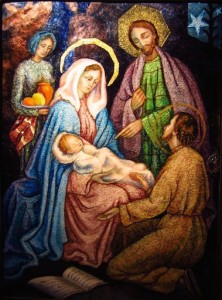
Finally, a somewhat enigmatic detail in this human genealogy is the place of women. Only five women are named in this lineage. For these five to even be named in a very patriarchal society is already no mean feat. But we also see in these five women, very strong characters–people who were able to risk all, even using very unconventional means, just to bring forward what seems was God’s path for them. We see here for instance the character of Ruth, a Moabite who stuck faithfully with her Jewish mother-in-law out of love and devotion and is rewarded with a marriage into what would be the line that would raise King David. We see the wife of Uriah, who became the lustful object of King David and whose figure set forth the chain of sins that would be the downfall of the great king–lust, adultery, murder, but in her person had become the path for raising the even greater King Solomon–figure of Wisdom. And of course at the end of the line, we have Mary of Nazareth, whose yes would finally bring the Word-made-flesh to our lives. She herself struggled through this choice, a choice that was not without risk of shaming and penalty (she would have been stoned to death, if Joseph had denounced her publicly!).
But why all these? Why would God choose this path to come into our lives? We would never know all there is to know in this mystery until we meet God face to face. But this we can say, God will not shrink before any possibility or path to enter into our lives–the vulnerable, the least, the most scandalous, the most sinful. God embraces the best and worst of our human lives if only to be in deep compassion and solidarity with us and to communicate to us God’s love in the best way possible. And God means to teach us too: honour what is human, seek out the Sacred, notice the Divine Wisdom etched in the very fiber of our being human. May we heed God’s call. God Bless!
To Pray on and Ponder: Isaiah 11, 1-10; Luke 10, 21-24
Have you ever felt so deep a joy that what you see makes you cry a cry of praise and then moves you to grateful, generous response? It’s as if an event becomes so transparent that you actually see and feel the face of God revealed, communicating to you some light of truth, confirming who you are deep inside or bringing you tenderness and comfort, protection and assurance that all will be well because everything in your life is in God’s hands. Perhaps we would need more contemplation to really fathom what moved deep in Jesus’ heart when in this Gospel scene in the 10th chapter of St. Luke, he is moved deeply as to rejoice in God’s Spirit and give praise to his Father. The seventy-two disciples, his second liners to the Twelve, had just returned from mission. And they were all ecstatic as they recounted to him the many wonders they had seen happen when they performed healings and exorcisms in his name. From these accounts, Jesus is filled with joy. The mission was fruitful and all were happy. He invited the disciples to go to a wayside place to settle down, to rest and recharge, review the experience and examine where their joy was coming from.
But before all else, Jesus utters a prayer of praise of his own: “I give you praise, Father, Lord of heaven and earth, for although you have hidden these things from the wise and the learned, you have revealed them to the childlike. Yes, Father, such has been your gracious will. All things have been handed over to me by my Father. No one knows who the Son is except the Father and who the Father is except the Son and anyone to whom the Son wishes to reveal him.” From the prayer we can infer at least some things which may have brought Jesus deep joy–first perhaps is that ministry under his name is fruitful; second, that Father has ordained that spirits may be subject to him and in his name, people may be redeemed; third, that disciples who believe in his name and remain in him while labouring in ministry may also make present God’s power and love and bring healing and redemption to their place of ministry.
I, for myself, resonate deeply with this sort of joy. I too experience profound joy and thanksgiving at the conclusion of many retreats where I felt God’s presence was really palpable. God was really engaging the ones I accompany and drawing them into really radical conversions, bringing order back into their lives. And sometimes, I am led to shed tears in private because my eyes have seen God re-enact again his saving grace in this or that person whom I had the privilege of guiding in a retreat. I could almost hear Jesus whispering to me as well what he told his disciples: “Blessed are the eyes that see what you see. For I say to you, many prophets and kings desired to see what you see but did not see it, and to hear what you hear, but did not hear it.”
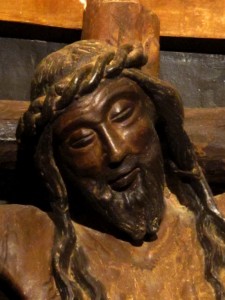
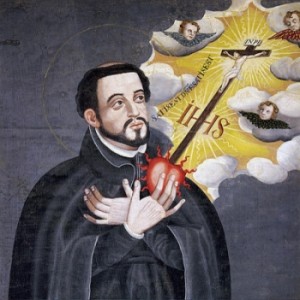
Today, the whole Church as well as our Jesuit and Ignatian families celebrate today the Feast of St. Francis Xavier, one of the first companions of St. Ignatius Loyola, zealous Jesuit missionary apostle to Asia and one of the Church’s Patron of Missions. (Curiously, the other Patron(ness) of missions is Doctor of the Church, St. Therese of Lisieux!). On this feast day, I am drawn to reflect: might there have been similar things that filled Francis Xavier’s heart with joy–such a joy that brought him from that Piazza del Popolo where the then Superior-General Ignatius sent him off as a missionary requested by the King of Portugal, a mission that would carry him to much more distant places like Goa in India, Malacca, Japan and finally the fringes of China where he died. What sort of joy animated this man and fired his zeal that he reached places to bring Jesus Christ to peoples who have not heard about him? Ironically, it is quite a unique cross that began young Francis’ devotion at the Xavier chapel–a cross with a smiling face of Christ.
This lovely, story of “The Return of the Seventy-two Disciples” helps us to pray as we enter more and more deeply into the spirit of Advent. We look at our hearts and ask, how can we prepare our hearts so they can radiate a little more of Jesus’ joy in seeing God moving about saving his people? In a sense the great missionary work of St. Francis Xavier was testimony to the Christic joy that Xavier carried in his heart all through his Jesuit life.. That Xavier’s missionary work brought him from Spain and Rome to the fringes of China is a wonder to think about and ponder on, and to think that what began that missionary journey was only the fortuitous turn of events that another Jesuit chosen to be sent to Portugal got sick. With the urgency of that sending, Ignatius reluctantly picked Francis Xavier, one reliable companion that he would have chosen to stay with him in Rome, but Ignatius decides what he deemed closest to God’s will and sends Xavier with the command, “Go, set the whole world on fire!” as if to say, “animate the whole world with God’s Gospel of Joy.” Xavier’s response was as quick and edifying as the disciples who left their nets and father the very instant Jesus sounded out his call: “Okay, Fr. Ignatius, just give me a minute to mend my cassock, and I’ll go.”
To be sure, Xavier’s heart was not as free and available in the beginning. The story goes that among the first original friends who lived together at the College of St. Barbe in Paris (i.e., Xavier, Ignatius and Fabre), Xavier was the rich and flamboyant one, the one who lived extravagantly and would often go to Ignatius to borrow money. In time though, Ignatius would invite Francis to make the Exercises and the young man was moved deeply by the Gospel line that goes, “What profit is it for a man to gain the whole world but lose his soul in the process?” Xavier’s desires radically changed in orientation from worldly to Divine service. His extravagance was transformed into zeal and passion, a “Divine impatience,” as it is often called, and from the time he left Rome, his passion for proclaiming the faith to peoples of other lands and traditions brought him to frontiers many missionaries had not reached before him. I recall an original Xavier’s theme composed for a video on Francis Xavier’s life that to my mind expresses well this so-called Divine impatience that Francis Xavier felt in his heart. Two lines especially move me in my own ministry of promoting Ignatian spirituality, giving retreats and spiritual direction and forming guides: “For even through the darkest night you’ll be my light. And there upon the strangest tongue I know I’ll hear your song In every stranger’s gaze I will see your face. And I’ll go on ‘til every race falls into your embrace. For there’s no better rest in this restless world than to hear and do your Word.”
As we continue to ask God to dispose us all for his coming, I pray that we become hearts that really see the coming Lord and be so filled with joy that in our remaining days we become so fired with the friendship and love of God so we ourselves brave the frontiers and bring that love to others. Here I share with you the song in full. My companions Johnny Go and Manoling Francisco are credited for this beautiful creation.
NO BETTER REST (Xavier’s Theme) Lyrics by Johnny Go SJ, Music by Manoling Francisco SJ
Give a sign, what’s on your mind
And I’ll leave my world behind
If you bid me so, wherever I go
I’ll find you there I know
Always before me you go
Both near and far, there you are
My one bright shining star
Well here I am at your command
Lead be my your hand.
Be with me when I sail the sea,
Where the winds reign free.
The rain may pour, and storms may roar;
An ocean without shore–
With You, my heart wants nothing more!
I’ll face the wind, the din within,
To ease Your children’s pain.
So here I am, at Your command:
Lead me by Your hand
For even through the darkest night you’ll be my light
And there upon the strangest tongue I know I’ll hear your song
In every stranger’s gaze I will see your face
And I’ll go on ‘til every race falls into your embrace.
For there’s no better rest in this restless world
Than to hear and do your word.









 To Pray on and Ponder: Genesis 49, 2.8-10; Psalm 72, 1-4ab.7-8.17; Matthew 1,1-17